Workforce
Workforce is where a department that is also an employer keeps what its people cost: the employer identity and establishments (physical locations), workers with their employment periods and job assignments, compensation profiles (base pay, differentials, employer costs), work entries (hours per day from payroll, deployments and calls) and annual pay facts (W-2 earnings, hours, weeks). It feeds Field Costing (what a bid, call or deployment really costs), the Cal OES MARS Salary Survey, and Pay Data Reporting.
Business Ops add-on with Workforce.InternalCosting. Menu: Workforce & Business Ops → Workforce (administrators and holders of a workforce permission).
Identifiers, addresses, pay rates, earnings, demographic responses and export files are Advanced Data Protection fields. They render REDACTED without a current Protected Data Grant (verify with your authenticator), are never cached or logged, and a REDACTED value left unchanged on a form keeps what is stored. Enrol the department in ADP before entering real pay data.
The pages
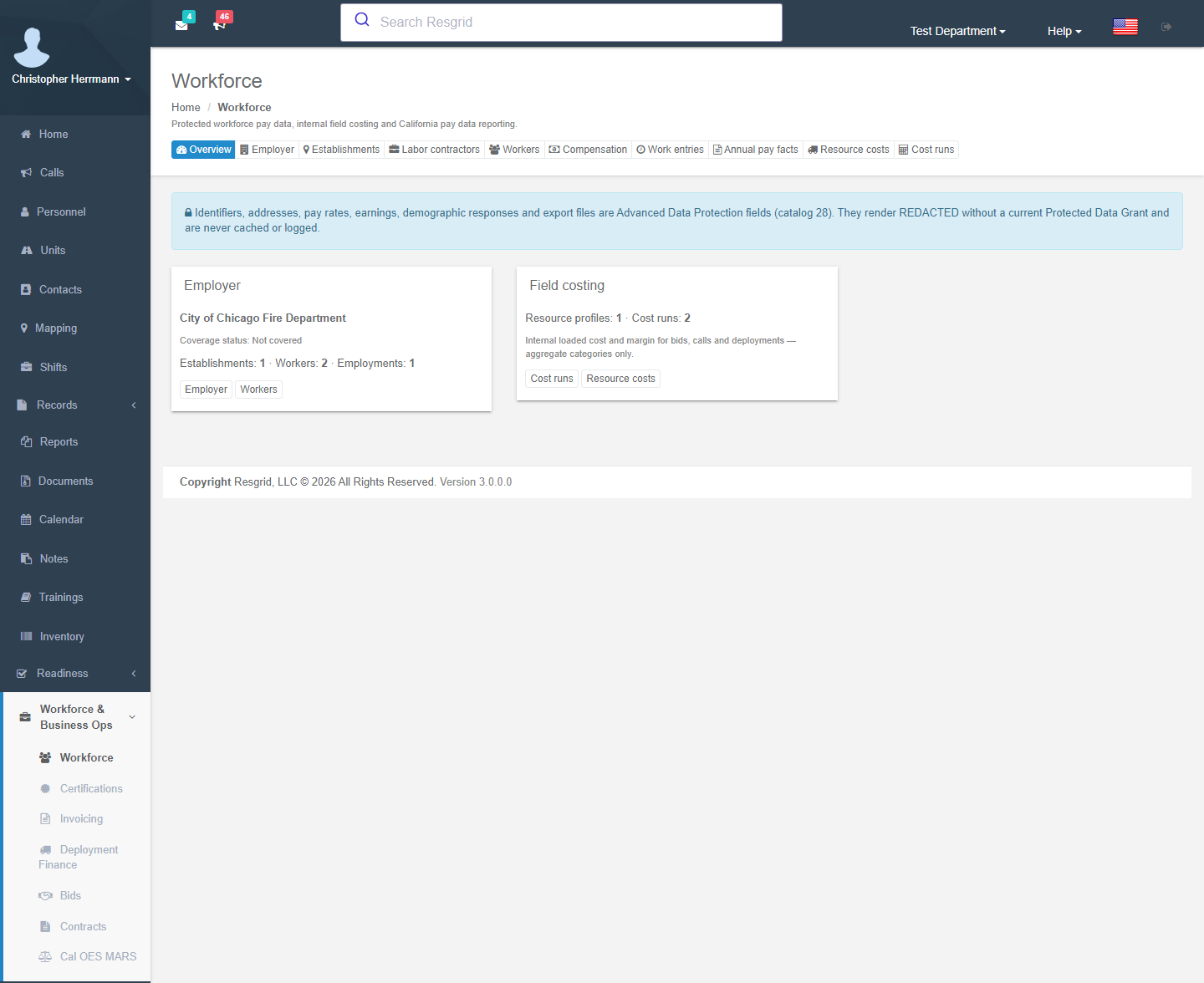
The workforce home shows three panels — Employer, Field costing and Pay data reporting — with counts and links.
Employer
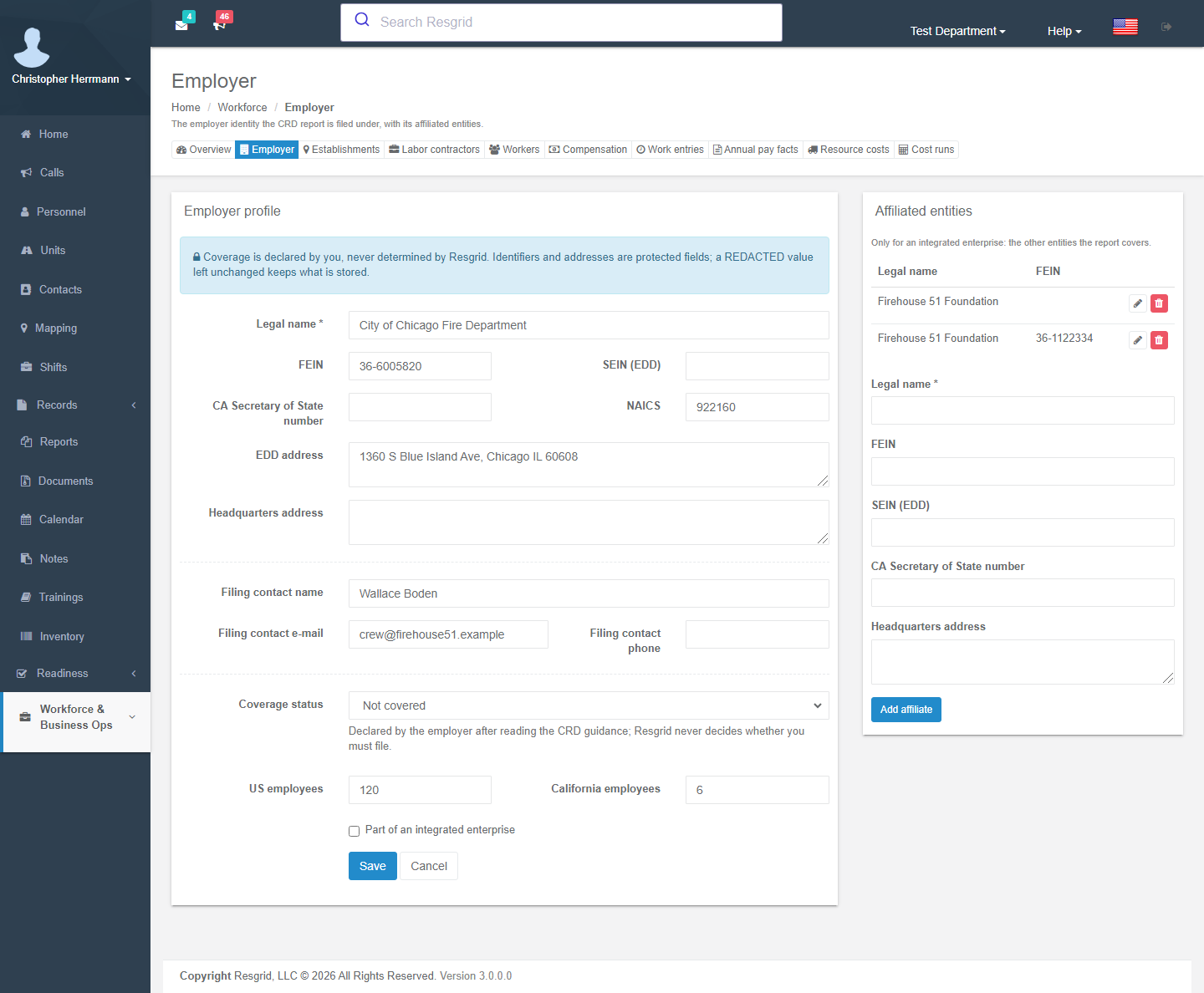
Workforce → Employer: the legal entity the CRD report is filed under — legal name, FEIN, SEIN (EDD), CA Secretary of State number, NAICS, EDD and headquarters addresses, filing contact, coverage status (Not covered, Covered — payroll, Covered — labor contractor, Covered — both; declared by you after reading the CRD guidance — Resgrid never decides whether you must file), US and California employee counts and whether you are part of an integrated enterprise (then list the affiliated entities).
Establishments
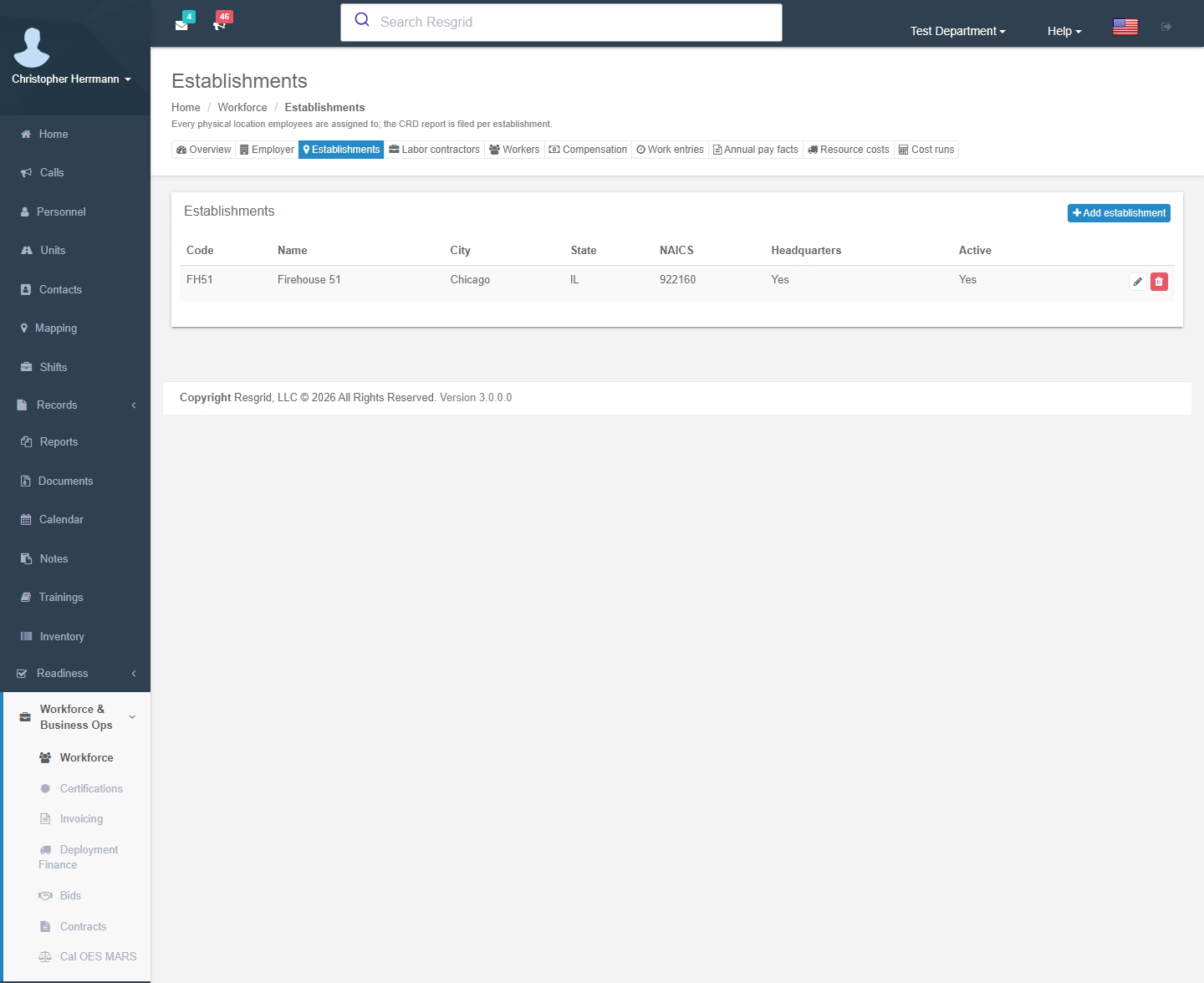
Workforce → Establishments: every physical location employees are assigned to — code, name, street address, city, state, ZIP, NAICS, major activity, affiliate, active window, time zone, Headquarters and Reported in the prior year. The CRD report is filed per establishment; a fire department's stations are usually one establishment each unless payroll treats them as one.
Labor contractors
Workforce → Contractors: firms that supply labor contractor employees (covered by the second CRD report) — legal name, ownership, DBA, FEIN or other identifier, contact details, relationship window and where the identity came from (contract, W-9, portal record).
Workers, employments, job assignments
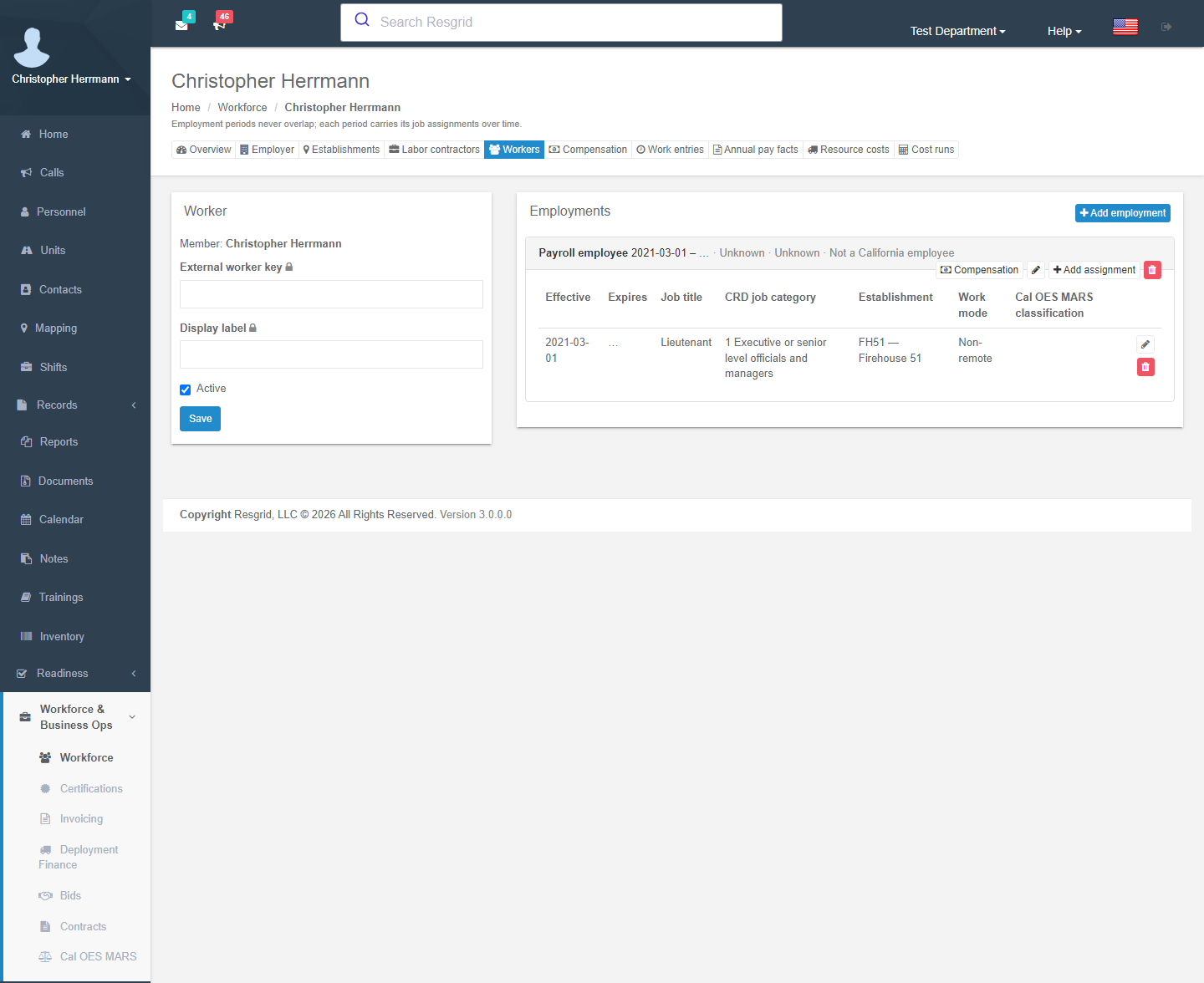
Workforce → Workers: every person you pay or report on. Add worker from a department member, or an external worker by payroll key and label (both protected). Open a worker:
| Section | Fields |
|---|---|
| Employments (never overlap) | Worker kind (Payroll employee, Labor contractor employee, Volunteer, Independent contractor), start/end, employment type (full-time, part-time, intermittent), exemption status, California basis (assigned to a California establishment, works in California, both, not California), default establishment, personnel role (used to pick a role-default compensation profile), labor contractor, affiliate. |
| Job assignments (per employment, over time) | Job title, CRD job category (one of the ten categories of the reviewed schema profile), SOC code and version, establishment, work mode (non-remote, remote within California, remote outside California assigned to a California establishment), work country / state, Cal OES MARS classification and authority profile, mapping provenance. |
| Compensation | Link to the worker's compensation profiles. |
| Demographic record | For a compliance officer to record a worker who has not self-identified (see Pay Data Reporting). |
Compensation
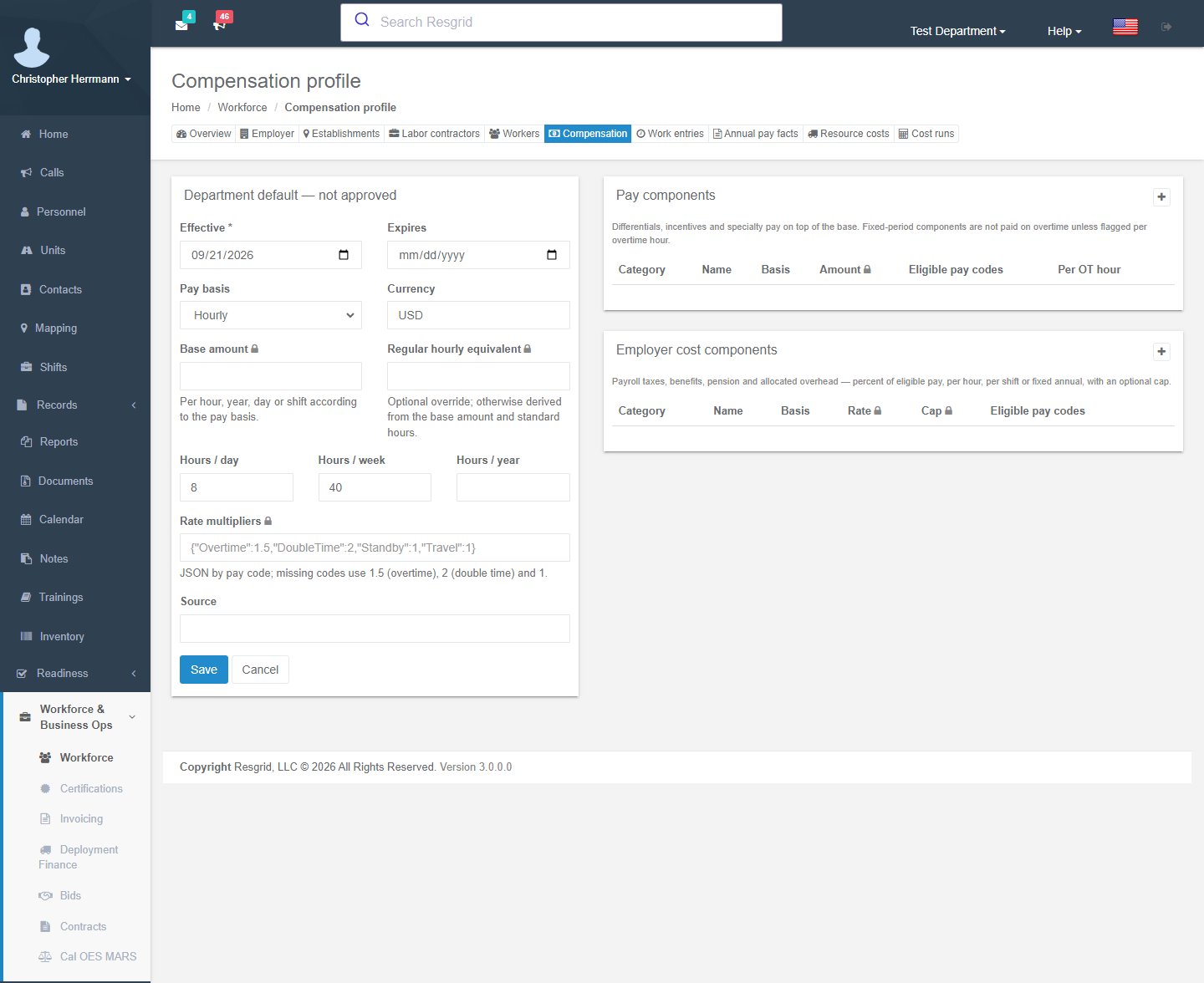
Workforce → Compensation (from a worker's page or the Compensation tab): employee profiles, role defaults and a department default. Estimates use the employee profile, then the role default, then the department default; the payroll system's approved cost always wins.
| Panel | Fields |
|---|---|
| Profile | Scope, effective/expiry, pay basis (hourly, salary, daily, shift, stipend), currency, base amount, regular hourly equivalent (optional override), standard hours per day / week / year, rate multipliers JSON by pay code (defaults 1.5 overtime, 2 double time), source. |
| Pay components | Differentials, incentives, longevity, education, EMS, hazmat, USAR, specialty pay — per hour, percent of base, per shift, per pay period or fixed annual, with eligible pay codes and per OT hour. |
| Employer cost components | Payroll taxes, workers' compensation, pension, health and other benefits, fixed labor cost, allocated overhead — percent of eligible pay, per hour / shift / day or fixed annual, with an optional cap. |
| Approval | Approve profile: unapproved profiles still price estimates but flag every line for review; any rate change removes the approval. The loaded cost of a regular 8-hour day is previewed. |
Work entries
Workforce → Work entries: hours per worker and day — hours type (regular, overtime, double time, standby, travel, paid leave, other), establishment, work mode and location, the call or deployment they belong to, and the approved payroll cost (when present it replaces any estimate for that day). Entries can come from payroll (external source and id), from deployments' time reports or be typed.
Annual pay facts
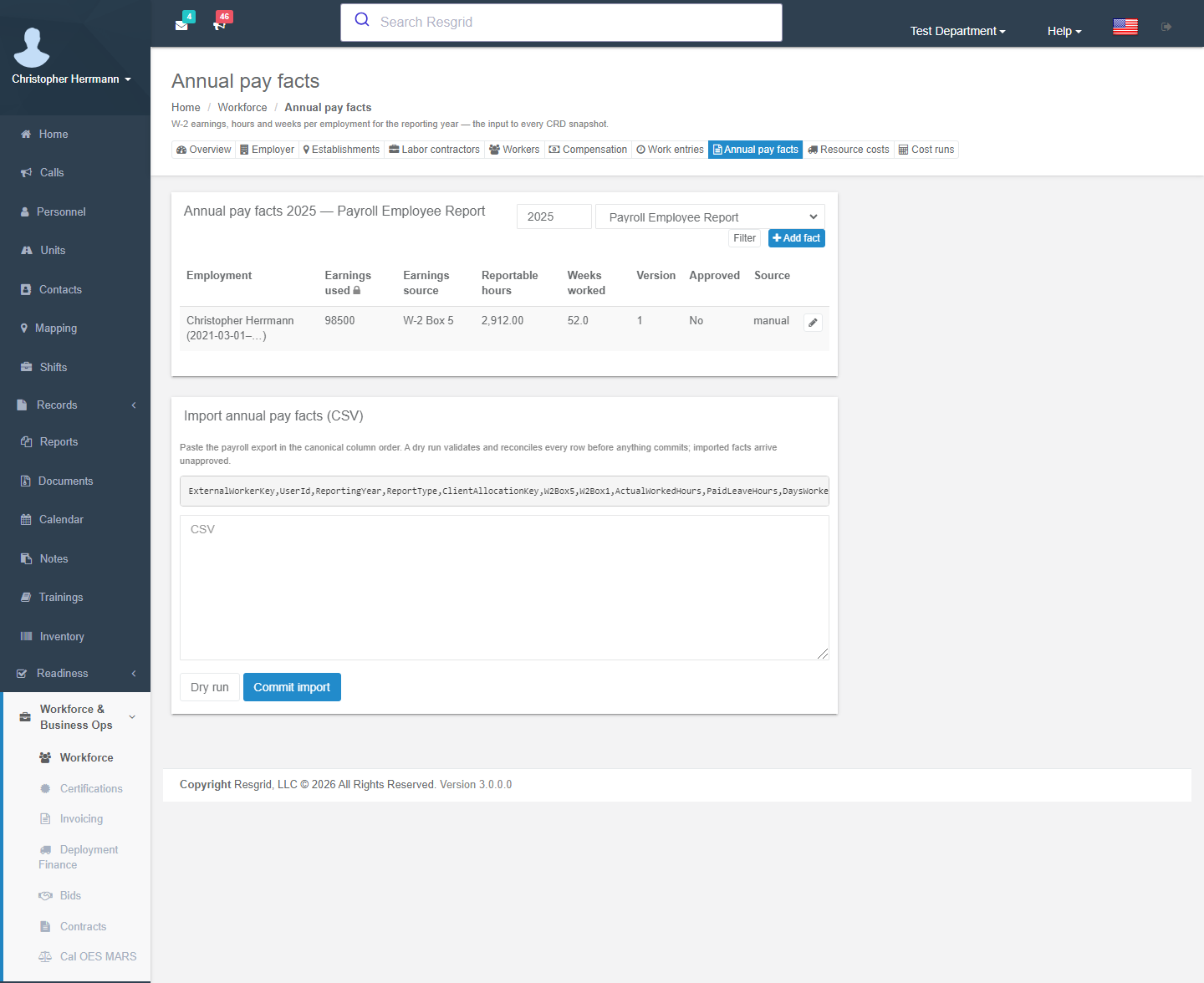
Workforce → Annual pay facts (per reporting year and report type): W-2 Box 5 (or Box 1 as fallback), client-allocated earnings for labor contractors, actual worked hours, paid-leave hours, days worked, an exempt-hours proxy method (actual + paid leave, or days × average hours), weeks worked, reconciliation flag and approval. Facts are immutable and versioned — correcting one creates a new version. Import (CSV) takes the payroll export in the canonical column order: a dry run validates and reconciles every row before Commit import; imported facts arrive unapproved.
Setup examples
| Organization | What to set up |
|---|---|
| Career fire department (California) | Employer + one establishment per station, every member as a worker with role-default compensation per rank, work entries fed from deployments, annual pay facts imported from payroll each January → CRD report and MARS Salary Survey. |
| Career fire / EMS outside California | Employer and establishments optional; compensation profiles per role and employer cost components so deployment cost runs and bid estimates are realistic. |
| Volunteer / combination department | Workers as Volunteer with stipend profiles; work entries per call to value volunteer hours for grants; no pay data reporting. |
| Wildland / security contractor | Employee profiles per crew member with overtime multipliers and per-OT-hour components; department default for bid estimates before the roster is known. |
| Industrial site | Workers per shift, establishments per plant, labor contractors for contract crews; compensation profiles for internal chargebacks. |
Technical reference
| Item | Value |
|---|---|
| Routes | /User/Workforce/{Index,Employer,Establishments,Contractors,Workers,Worker,Compensation,CompensationProfile,WorkEntries,AnnualFacts} and their Save*/Delete* POSTs; ImportAnnualFacts (dry run / commit) |
| Model | Core/Resgrid.Model/Workforce/ — employer profile, affiliated entities, establishments, labor contractors, workers, employments, job assignments, compensation profiles + pay / cost components, work entries, annual pay facts (versioned); WorkforceProtectedFields = ADP catalog 28 (41 columns; decimals stored as protected text) |
| Permissions | Manage workforce and compensation (75), View workforce compensation (76) — plus a current Protected Data Grant to read values |
| Flag | Workforce.InternalCosting (child of Business.Operations) |
| Config | WorkforceConfig (overtime threshold 8 h/day, usage conflict 10 %, export retention 30 days, filing season Jan–May) |
| Services | IWorkforceService, IWorkforceImportService, ICompensationCostService (employee → role → department fallback; approval dropped on rate edit) |
| Search | Workforce data is never indexed |